
- AI is a useful tool in the hiring process, but the final decision about people always remains with a human.
- Candidates rely heavily on AI when applying and use it to tailor their applications, but not always in ways that are genuinely helpful.
- AI can help with structuring candidate evaluations, improving email templates, and interview preparation — but always under our supervision.
- The recruiters who use AI most effectively are exactly those who understand its limitations.
Artificial intelligence has become a regular part of the talent acquisition toolkit. Resume screening, interview scheduling, evaluation frameworks, candidate communication — it’s hard to find a stage in the hiring process that automation hasn’t touched. And while the efficiency gains are real, so is the risk of losing something essential along the way.
At our TA team, we had to ask ourselves a direct question: what exactly are we delegating to the machine, and what must always stay within the team? The problem arises when automation becomes a wall, not a bridge; when candidates lose their authenticity trying to satisfy software requirements rather than people. In this blog, we share how we drew that line.
So, what happens when AI takes the lead in hiring?
When AI-powered screening tools became widely available, the promise was hard to ignore: faster filtering, reduced manual work, greater consistency across large volumes of applications. We tried them all. We learned from them. And the more we leaned on automation, the more clearly we saw its limits.
The strongest signal came when we started noticing candidates embedding invisible keywords into their CVs using white text in the background, designed purely to achieve better rankings in automated screening.
It was a direct response to a world where an algorithm, not a person, makes the first call on someone’s application. And it told us something we couldn’t ignore — when candidates feel evaluated by a machine, they respond by trying to “hack” it.
This dynamic slowly but surely erodes the quality of any hiring process. It rewards “manipulation” over merit and filters out exactly those authentic, self-aware candidates you want to find.
It was a clear sign that human review isn’t optional — it’s the safeguard the entire process depends on.
With over 1,000 applications per month across more than 15 open positions, the temptation to automate the hiring process is understandable.
How we actually use AI, and where we draw the line
Our rule is simple: no candidate reaches the shortlist without a member of our team reviewing their application.
AI plays a supporting role, but every CV goes through a check by someone on our team before any decision is made.
In practice, this shapes several areas of our work.
Reviewing CVs and cover letters
When reviewing CVs and cover letters, we look at far more than keywords.
We assess how someone communicates, how they present their experience, and what their story says about their mindset and motivation.
We’ve noticed a steady rise in AI-generated cover letters — flawless in form, but often lacking substance.
When we spot them, we look for concrete signals:
- perfect structure with no personal note
- generic phrases that could accompany any position at any company
- absence of specific examples from practice
- overly formal tone that doesn’t match the rest of the application
An authentic cover letter almost always contains something specific: a connection to the particular role, a reference to what drew them to that position, or simply a sentence that sounds like it was written by a person, not a tool.
Interview preparation
For interview preparation, we use an AI assistant that our TA team has specifically tailored to our needs.
Based on the role description and job ad, the AI suggests relevant questions for different competencies to assess required skills and traits during the conversation.
This gives us a solid starting framework and saves time, but every interview kit is reviewed, adjusted, and aligned by our recruiters with what the hiring manager is specifically looking for.
AI sets the structure; our team shapes it.
Over time, it learns from our inputs and corrections — adapting its suggestions to better reflect our culture and what we’re truly looking for.
Candidate evaluations
We apply a similar principle when writing candidate evaluations for hiring managers after interviews.
AI helps us structure the presentation based on the bullet points the manager wants to see and keeps the format consistent and fair, regardless of who conducted the conversation or how many candidates are going through the process at the same time.
The content, however, comes from the recruiter who was in that conversation — and here we make no compromises.
The hiring manager needs a genuine impression from the interview:
- what energy the candidate brought
- how passionate they truly are about the role
- what motivates them
- where their strengths lie
- where we see room for development
None of those details can be automatically generated.
This requires someone who sat across from that candidate and can credibly articulate what they actually observed.
AI here plays the role of editor of form, not author of content.
And precisely that distinction — between a tool that enhances the process and one that replaces it — is something we consciously protect in our team.
Our internal review process
Our internal review process rests on a few simple principles.
Every CV is read in its entirety, not scanned.
The evaluation includes:
- whether there is a clear pathway in the candidate’s career development
- how they communicate in writing
- whether the cover letter shows motivation and understanding of the role
- whether there are signals of cultural fit
Hiring managers receive a shortlist with a brief recruiter comment alongside each profile — not just data, but an observation: why we felt this candidate was worth a conversation.
In candidate communication, we use AI to improve the baseline of our email templates. But we make a deliberate effort to write individual messages whenever possible.
A candidate who invested time in their application deserves more than a copy-paste response.
Candidates are people, not entries in a database.
Our recruiters report that this approach gives them more meaning in their work. When AI takes over repetitive tasks, space opens up for what they actually love: understanding people.
The biggest misconception about AI “neutrality”
There’s a widely held belief in hiring that AI removes bias — that replacing human judgment with an algorithm leads to fairer outcomes.
We’d like to push back on that.
AI is only as neutral as the data it was trained on and the processes it was designed to replicate.
If those processes carried bias, the algorithm carries it forward — just faster and at a far greater scale.
The tool doesn’t solve the problem; it scales it.
But the more common misconception is simpler: that AI is comprehensive enough to replace recruiters entirely.
It isn’t.
A CV is more than a list of qualifications; it reveals how someone thinks, how they express themselves, and how they’ve built their career.
Reading that requires human intuition.
Assessing commitment, energy, cultural fit, and authenticity are not things an algorithm can reliably do.
What does it actually mean to use AI well in hiring?
Here’s something we’ve noticed:
Responsible use of AI in hiring demands more from recruiters, not less.
The skills that matter most are exactly those AI cannot replicate:
- reading between the lines of a CV
- critical thinking beyond what’s on paper
- assessing motivation and fit through emotional intelligence
- knowing when AI is helping and when it’s getting in the way
Recruiters who understand the tool’s limitations are the ones who use it best.
They use it for:
- efficient structuring
- saving time on repetitive tasks
- consistency in tone
And they protect the human element in the moments that matter most.
Building teams is still a human job
AI has a real and valuable place in modern talent acquisition. It helps us work faster, stay consistent, and manage volume without sacrificing structure.
But it works best when it has a clearly defined place.
The teams that will hire most successfully in the years ahead won’t be those who automate the most.
They’ll be the ones who stay genuinely curious about the people behind the applications.
Start by analyzing where AI is currently influencing your decisions and honestly ask yourself whether the human eye is still in the loop.
Protect the moments in your process where judgment, empathy, and genuine human connection are irreplaceable.
The teams we build through this approach don’t just fill positions — they shape a culture we’re proud to be part of.
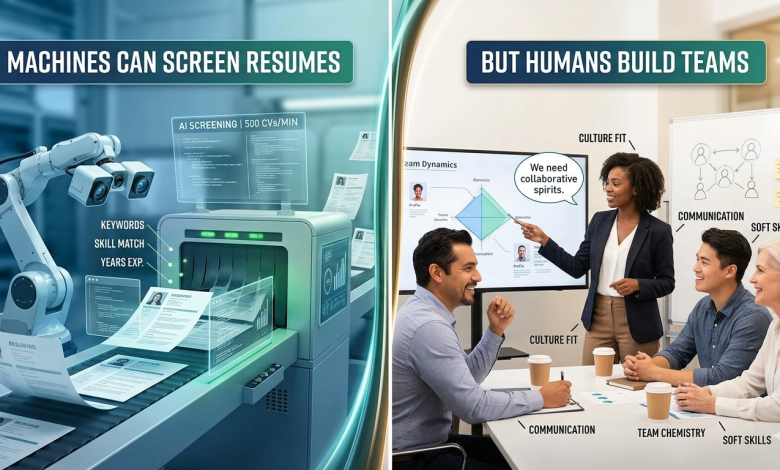
Because machines can screen resumes. But only people can build great teams.
Tijana Tadić and Martina Petrić, Gentoo Media