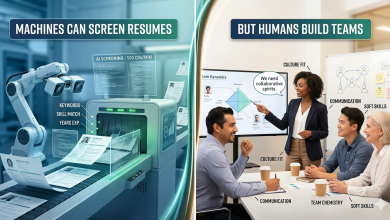

Let’s be honest – AI isn’t knocking at the door anymore. It’s already in. From how we screen candidates to how we plan for workforce shifts, artificial intelligence is becoming a part of HR whether we like it or not. The potential is exciting, but the questions it raises are real: Are we using this technology in a way that supports people? Are we even ready? Do we really know how to use AI at all?
According to the World Economic Forum, nearly half of all work tasks could be impacted by AI in the next few years. But most HR teams are still figuring out what that actually means for them. Deloitte found that only about one in five HR leaders feels confident using AI to shape workforce strategy. There’s a clear disconnect between what’s possible and what’s actually being done.
So let’s talk about it – without the buzzwords. This article is about what HR can do to bring in AI responsibly, in a way that strengthens – not weakens – our role in organizations.
Where AI Can Actually Help
If we strip away the hype, what AI offers HR is time. Time saved on repetitive tasks. Time to catch problems earlier. Time to focus on the things that require human judgment – like conversations, coaching, and culture.
Used well, AI can help us identify the early signs of burnout or disengagement. It can suggest better ways to structure development paths. It can even catch subtle patterns in employee data that we’d probably miss on our own. In recruitment, AI can help streamline screening and flag potential bias in job descriptions. SHRM reports that organizations using AI in hiring often reduce time-to-fill by up to half.
We’re also seeing AI being used to personalize learning at scale. Rather than pushing the same training to everyone, some platforms now adapt content based on people’s needs and learning styles. That’s the kind of support employees actually notice – and appreciate.
But as Josh Bersin often reminds us, tools don’t create impact. People do. And he is not alone, Dave Urlich agrees on this as well. The smartest AI in the world won’t fix a broken culture or a leadership vacuum. That still falls on us.
The Risks Are Real – So Let’s Be Honest About Them
It’s tempting to paint AI as a silver bullet, but it’s not. And when we don’t handle it with care, it can do damage. One of the biggest risks is trust – especially if employees feel like decisions are being made about them by a system they don’t understand.
This is where things get personal. If someone loses out on a promotion or gets flagged for performance risk, they’ll want to know why. If the answer is “the algorithm said so,” we’ve lost the plot.
The CIPD has raised valid concerns about the ethical use of AI in people decisions. Bias doesn’t disappear just because you run a process through software. In fact, without careful oversight, it can become harder to spot – and harder to challenge. The old saying that tags along this and explains the phenomenon claims – „garbage in, garbage out“.
On top of that, many HR teams simply haven’t had the chance to build up confidence with these tools. A recent Bersin report said that only 11% of HR leaders feel equipped to lead AI adoption. We’re being asked to evaluate technologies we were never trained for. That’s a tough spot to be in – and one we need to name, not ignore.
Doing It Right Means Slowing Down to Think
The HR teams getting AI right aren’t the ones rushing to adopt the latest tool. They’re the ones asking better questions. Some of these questions being asked are:
- What problem are we solving?
- What could go wrong?
- Who needs to be involved?
- And how do we make sure we’re still acting on our values?
Some have started creating “AI use charters” internally – simple guides that lay out principles like transparency, employee involvement, and fairness. Others are pairing HR professionals with data scientists to evaluate tools before rollout. None of this is flashy, but it’s the kind of thoughtful groundwork that builds trust. If you would like to know more, look at what IBM and Accenture are doing for example.
We also need to involve the people affected – early and often. Tell them what’s changing, why it matters, and how it’ll be used. Ask for feedback. Create a space where concerns are welcomed, not dismissed. That’s how you build the kind of culture where innovation can actually take root.
And most importantly, we have to measure more than efficiency. Sure, faster processes are great. But we should also be asking: Are people feeling seen? Are decisions fair? Is trust going up or down?
That’s what makes the difference between an automated process and a people-first one. If this seems somehow familiar to you, it is the usual scheme we use when changes are applied, no matter of the model and author you use in change management rollouts.
The Future Is Tech-Driven – but Still Human at Its Core
We’re not here to compete with machines. We’re here to make sure the machines are helping us do better by our people.
Yes, AI can make HR more effective. But without us guiding its use, it can also make things colder, faster. Our role is to be the compass – not just the operators. We decide what matters. We decide what’s fair. We decide when to slow down, ask questions, and bring empathy into the equation.
Some HR teams are already showing us what this looks like. They’re blending tech and trust, using data without losing touch, and leading their organizations into the future with confidence. These are the people we should be learning from – and celebrating. Recognizing these individuals through awards like HR Manager godine does more than applaud personal success. If your team is already cracking the code or you know who is, please apply for HR Manager godine.
Because in the end, HR isn’t about keeping up with tools. It’s about shaping cultures where people can thrive – even in a world powered by algorithms.
Let’s make sure we keep it that way.
Author: Mirna Koričan Lajtman, PhD, HR Consultant and Associate Professor at Luxembourg School of Business and ZSEM